

An overlooked element of supply chain logistics are pallets; over 80% of all world trade is currently carried out using pallets. The pallet industry is worth 77 billion dollars in 2026, with the plastic pallet market increasing its market share.
Pallet Types
With a variety of materials for pallet construction, here is a short list of materials and average life cycles. A cycle means loading and unloading a delivery.
| Material Type | Life Cycles |
| Paper | 1-5 Cycles |
| OSB | 5-10 Cycles* |
| Wood | 5-30 Cycles |
| Plastic | 50-100s Cycles |
| Aluminum | 100s Cycles |
| ULDs | 100s Cycles |
*Research found limited information on the life cycle of OSB pallets.
Paper Pallets
Cardboard or paper pallets are single-use items, depending on the durability required for the shipment. Options include light, medium, and heavy loads – they are as versatile as plastic pallets with a lower carbon footprint.
IKEA, an international home furnishings outlet, has phased out the use of wooden pallets and switched to recyclable paper pallets since 2011. Circular Supply Chains states that it is due to “the fact that wooden pallets currently account for 50 percent of the company’s total global use of pine and spruce.” While workers can refurbish and reuse wood pallets, they will store or burn 54% of them, or send them to landfills, after using them only once.
IKEA decided to move to low-profile cardboard pallets for its shipments. This saves them weight (average weight of 5.5 lb or 2.49 kg) on every load, and they can be easily customized to better suit the needs of the products being shipped. “When we open the store, it is much easier to maintain the commerciality and safety of the sales floor because we can keep reducing the size of the cardboard pallet as the merchandise sells, recycling as we go,” explains IKEA Portland store manager Alex Zini.
This switch to cardboard pallets saves IKEA $193 million per year.
Paper pallets use wood pulp from virgin wood or recycled paper. Being pressed together, paper pallets are free of nails or staples – adding a layer of safety to the design.
Oriented Strand Board (OSB)
OSB is an engineered plane and rigid wood panel made of wood strands of selected quality with controlled cross orientation, bound with a synthetic resin under high temperature and pressure conditions. Manufacturers can use it for the construction of homes and crates for shipping.
Founder of Warehouse UK, AJ Mills-Mohomed, says “OSB pallets don’t offer that same flexibility [as wooden pallets].”
“If the board cracks, delaminates or suffers structural damage, repairs are usually impractical and rarely cost-effective. In most cases, they’re replaced rather than repaired, particularly where safety and load integrity are important. We generally see OSB pallets used where consistency, lighter weight or export compliance are the priority, while timber pallets remain the preferred option for closed-loop supply chains where pallets are collected, repaired and reused over multiple cycles.”
Wooden Pallets
Wooden pallets are the most popular type in use throughout the globe. These pallets are all white wood with no bark, and are often heat treated to meet international standards (look for the stamped HT symbol) to prevent the spread of contamination in the supply chain. Removing bark is important as pallets need to have a flat, clean surface for the goods they will carry. Bark is also a vector for insects and pests to live in. Manufacturers construct them with nails or staples, and workers can easily repair them with new materials.
CEO of Fullfil.com, Joe Spisak, says repairability is a major factor in using traditional wooden pallets. “Standard wood pallets get that 5-30 trip range because they’re repairable. A stringer cracks? You swap it. A deck board splits? Replace it.”
“Wood pallets have a massive repair infrastructure – there are pallet recyclers in every industrial area.”
Compared to plastic pallets, wooden pallets have a shorter lifespan, lasting an expected 5 to 30 cycles before users must replace them. Pallets that require repairs will not be as strong as a new pallet.
Plastic Pallets
Plastic pallets have a greater life cycle than wooden pallets, averaging around 50-100 cycles – plastic pallets are the ideal base for food and pharmaceutical shipments that have cleanliness requirements. Manufacturers form these pallets in a single press, ensuring a clean, even surface. These pallets can be easily cleaned, making them ideal for perishable goods that require clean environments. Depending on their construction, they can be as strong as wooden pallets for static loads.
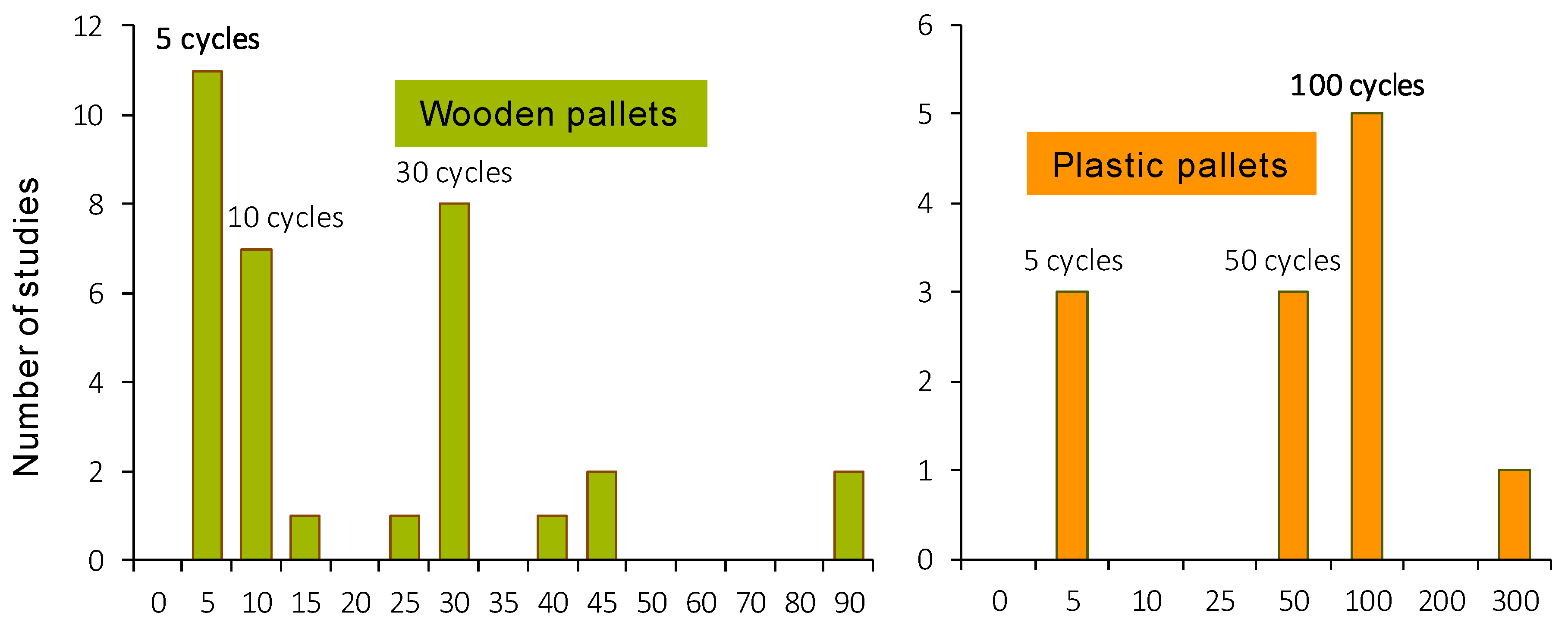
No one can repair plastic pallets, but recyclers can melt them down and reform them. Overall, plastic pallets have a greater negative environmental impact compared to wooden pallets based on the amount of oil used in their production. “If secondary plastic is used for pallet production, their environmental impacts are lower in several impact categories than wood pallets without energy recovery at their end-of-life.”
Aluminum Pallets
Aluminum pallets have a long shelf life due to their durability and construction. With a heavier weight profile than wooden or paper pallets, it is more difficult to move without assistance.
Due to their construction, they are fire-resistant and do not require fumigation or heat treatments like wooden pallets.
With a higher initial cost than plastic or wooden pallets, their life cycle does not end like wooden pallets. At the end of their lifetime, if the pallet has become too damaged for normal use or minor repairs, they can be re-cast into a new aluminum pallet.
PMCs/ULDs
Manufacturers build PMCs or Unit Load Devices (ULDs) out of aluminum and use them only for air freight. They design them to move easily in an air-cargo environment. Manufacturers design them for movement by roller beds that airlines and warehouse and trailer operators install in planes, warehouses, trailers, and other facilities.
ULDs have a flat bottom to take advantage of the roller bed systems used for air transportation. Coming in a variety of shapes and sizes, PMCs are the most common pallet type used in air cargo.
Because these pallets resemble cookie sheets, workers must secure cargo to them with straps and netting.
Building A Shipment
Constructing your pallet of goods requires careful attention to height and width restrictions. Domestic deliveries can use regular wooden pallets, but international deliveries will require heat-treated pallets. Please include the measurements of the pallet in the final dimensions.
- ISPM-15 Certification: ISPM-15 standards require wood to be heat-treated or fumigated to prevent pest transmission.
- Material Choice: Shippers prefer plastic and metal pallets for international shipping because these pallets do not require fumigation or treatment.
- Size Standards: European and U.S. pallets differ in dimensions; ensure that pallets fit the destination’s standard pallet racks and handling equipment.
- Carrying Capacity: The pallet must support the weight of the cargo and allow lifting by forklifts or pallet jacks.
- Durability: Pallets must be free from damage to prevent accidents during handling.
Pallets add to the weight of your shipment; alternatives such as plastic pallets are lighter compared to wooden pallets. Choose the best pallet based on your destination, budget, and weight requirements. Do not use cardboard or pressed wood pallets for air freight.
Stack your pallet by carefully placing your products on top of the pallet and enhancing their protection using items such as edge protectors and stretch film. Edge protectors stabilize your pallet and protect packaging from damage by straps.
Prevent overhangs, or cargo that hangs off the side of the pallet. Overhangs can cause a load to shift during transport and damage the contents of the shipment. Using stretch film to wrap a pallet is best practice to prevent any movement during transport.
Stretch film and tarps also serve as protection against the elements, as air cargo can spend some time outside before being loaded onboard.
American Airlines details important information in preparing your shipment for air cargo; make sure it can:
- Withstand 8 to 12 physical handlings.
- Withstand pressure of up to 60 lbs/27 kgs per square foot.
- Slide on any surface.
- Withstand a 12-inch drop to any surface.
- Tolerate 30 seconds in the rain.
Modern Upgrades
With the reduction in price of RFID technology, pallets can have embedded tracking systems to help track their movements through the supply chain. RFID solutions don’t require a direct line-of-sight to scan items, which allows you to scan multiple items simultaneously.
Alongside the upgrades in technology, locating a shipment or updating its delivery status is automatic. Although they have initial high-startup costs, the efficiency gains from RFID solutions outweigh the capital investment.
A Pallet for Every Challenge
The role of the pallet in logistics is undeniably important. With new materials built to outlast wooden pallets, traditional forms of shipping can gain an efficiency boost with the correct base layer. Tailoring your packaging materials is the best method for increased shipping efficiency.
Want more from US Cargo Link? Sign up for our monthly newsletter for the latest tools and updates.